

A Sky on Fire — Texas 1997
We know what we saw and at the same time do not know what it was we were looking at.
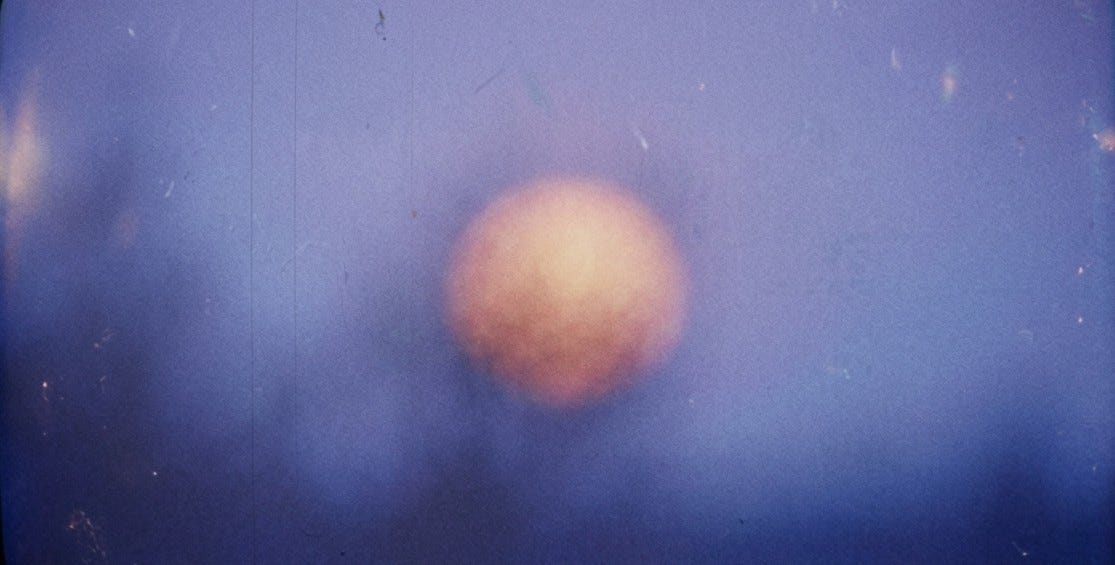
One late Texas afternoon in November 1997, my older brother and I were in the sunroom of our childhood home. This room had floor-to-ceiling windows that provided an open view of the entire backyard, including our dog in his kennel, three large oak trees, and a clear view of the cloudless, darkening sky. The stars had not yet come out when our little sister, who was celebrating her ninth birthday, came to ask us where our parents were (they had gone out to pick up her cake). She started asking us if we knew when they would be back, but before she could finish, she pointed up toward the sky, where a lenticular golden object hovered silently at what appeared to be about 100 feet above the tree line.
As the three of us looked on, a sudden chorus of barking and other animal sounds erupted throughout the neighborhood. Shocked, our attention was split between the object and our dog attempting to tear its way through the kennel’s wire. Still and completely silent, the object shone with a fire-like intensity before disappearing in the blink of an eye.
No one was keeping track of time, but the whole event must have lasted less than one minute, and as suddenly as it appeared, it was gone, along with the unease it brought to humans and animals alike.
To this day, the three of us do not dispute the details of this experience. We know what we saw and at the same time do not know what it was we were looking at.
To the credit of our parents, they never called us crazy or told us we didn’t see what we thought we did, but rather greeted this experience with an acceptance and curiosity that has likely helped us meet subsequent experiences with a degree of emotional resilience.
To the credit of our parents, they never called us crazy or told us we didn’t see what we thought we did, but rather greeted this experience with an acceptance and curiosity that has likely helped us meet subsequent experiences with a degree of emotional resilience.
That encounter established a distinction I would not fully appreciate until much later: an experience could be shared while its meaning remained entirely unsettled. Nearly three decades later, that distinction would become much harder to ignore.
Through the Trees, Not Among Them
The objects weren’t navigating the physical space of the forest; they were passing through it as if overlaid onto our reality.
In the years that followed, astonishing, beautiful, and frightening things have happened to me and those around me. The 1997 sighting gradually became less an isolated childhood memory than a reference point against which later experiences were measured. There is no adequate explanation, nothing that I can say that assuredly points to origin or intelligibility. Still, I believe that these experiences transform us in radically fundamental ways. What if you dreamed things that later came true? What if you saw and experienced things that by any measure of normality should not exist? Is there a name for such a thing? Though never satisfied to be told that the answers to these questions were to forever remain elusive, I stumbled onto an avenue unconventional to me that has since led to some potential understanding. That avenue was my burgeoning faith. If people like … are to be believed, the innermost gateway through which the phenomenon can be most directly accessed is through experience itself. And if those same people are correct, then there is a rather uncomfortable interaction between the concepts of spirituality and consciousness that play a yet-to-be-determined role.
The period of my life during which the most intense anomalous activity occurred followed the dissolution of my marriage of twelve years in 2024 and subsequent period extending through early 2025. Most of my life I have considered myself agnostic—raised Roman Catholic—but for the first time in over two decades, I dove into scripture and attended church with a conviction unlike any I had ever experienced in an attempt to turn my life around and a genuine desire to intuit my way toward something I had felt pulled toward most of my adult life.
Even so, as my faith intensified, so did the strange things happening around me. There were repeated sightings of golden lenticular objects hovering above tree lines, dissonant voices from no identifiable source, eerie synchronicities, and dreams that appeared to anticipate events that later came to pass. Some of these experiences occurred when I was alone; many others were witnessed by people around me.
That winter, a major weather event had blanketed a large swath of the southern Appalachian region, where I lived at the time, in several inches of snow. Closures were widespread, with many of the hilly, semi-paved roads deemed impassable. Our house was situated in a quiet, secluded, wooded area within walking distance of a lake and a farmer’s field to the north.
It was against this backdrop of isolation that two specific incidents took place. On January 24 and January 31 of 2025, my significant other and I were sitting down for dinner. It was nighttime, around 8:30 PM, when something outside the largest of the kitchen windows caught my attention.
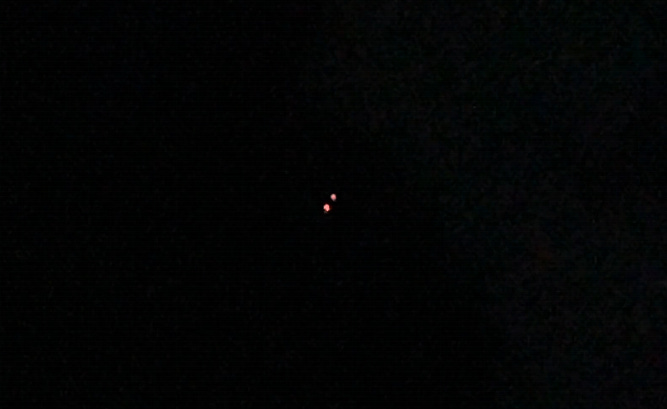
Three bright red, orb-like objects, equidistant from one another, much like the lights on a traffic signal, were traveling in unison from right to left across my field of vision. There was no noise, the lights were not flashing. However, the hair on my body stood straight up as the air grew heavy with what felt like a massive charge of static electricity. I motioned for my partner to look out the window, frozen in place as I tried to track their movement.
To my astonishment, she couldn’t see them, even as I was staring directly at them. Afraid I would lose sight of the objects, I walked right up to the window. This is where I noticed that these objects were moving through the trees, not among them. This didn’t make sense. For those old enough to remember, it looked exactly like when your elementary school teacher slid a transparency sheet across an overhead projector. The objects weren’t navigating the physical space of the forest; they were passing through it as if overlaid onto our reality. It simply didn’t make sense. I blinked and just like that, the objects were gone.
We spent some time talking about this, but as she hadn’t witnessed it, there wasn’t much use in evangelizing what I saw. That is, until the following week, where three of us would witness it.
The setup was identical: dinnertime, night, roughly the same time, with the two of us joined by another family member. We were in the middle of a discussion about cars when the kitchen window caught my attention once again. There they were—the same three red, orb-like objects. Pointing to the window, the visiting family member and I both stood up. Unlike the first incident, we were both looking at the exact same thing. We edged closer to the glass. The characteristics were identical, except this time the objects were moving much slower than they had a week prior.
Their color was hyperreal, meaning that it seemed more vivid than any shade of red that naturally exists in our reality. My partner, who was still sitting down, finally got up from the couch, met us at the window, and exclaimed that she could now see them too. Once again, from right to left, the objects slowly moved through the forest as if projected onto our field of vision. As they drifted toward the far-left corridor outside our primary vantage point, almost out of view, two of us spotted another object. It looked like an elongated prism, flashing an unpredictable, kaleidoscopic pattern of colors. By this time, my partner had run outside to try and get a better look at them—something I found quite reckless at the time. There is little recollection about how this all ended, but I vaguely recall an unsteadiness followed by a gradual vanishing of the objects (think of the lingering smoke when a candle goes out).
Interpretations vary among the three of us regarding what we saw. Awe, terror, and wonderment most accurately describes the emotions following this experience. The youngest among us adamantly charged that we shouldn’t go looking for these things and what they mean, my then-partner’s take was quite the opposite. Like my experience in Texas, several decades before, there was an air of something unsettling, foreboding, that I couldn’t make sense of or couldn’t shake off. Still, after we had retired for the night, my former partner and I both agreed that its crossing felt like a warning.
Red orb-like and luminous objects are not uncommon in UFO/UAP lore: Malmstrom Air Force Base (1967), the Rendlesham Forest Incident (1980), World War II “Foo Fighters” (1944–1945), the infamous Hessdalen Valley Field Lab Lights (Norway, 1980s–Present), Minot Air Force Base (1968), and most recently Release 3 of the Presidential Unsealing and Reporting System for UAP Encounters (PURSUE) all feature descriptions of objects similar to the ones we saw. Interestingly, Release 3 of PURSUE featured footage that eerily resembled what we witnessed during those two nights in 2025.
The resemblance was tempting, but resemblance alone is not explanation. If anything, finding echoes of these experiences elsewhere only complicated the question of what had actually occurred despite every instinct in me wanting to assign parity.
Did my growing faith somehow intensify the anomalous experiences themselves?
The Problem of Interpretation
The similarities do not tell me what we saw. If anything, they sharpen the problem of interpretation.
So much of this field seems to suggest that one must rely on intuition even to begin to understand it. Yet intuition is itself part of the cognitive minefield—a modern-day Tower of Babel in which biases flourish and disparate, unstructured concepts are assembled into patchwork attempts at theory. Perhaps we have simply not arrived at a framework capable of explaining what is happening. Or perhaps there is something about the way we understand and communicate these experiences that prevents us from seeing beyond traditional models.
Herein lies one of the seductive traps of UFOlogy: in the absence of meaningful constraints, almost any idea can be made to seem plausible. People approach this topic with stern seriousness, and there are plenty of reasons to do so. But rigor should not mean restricting ourselves only to questions that existing methods are already equipped to answer.
On the Joe Rogan Experience episode #2091, Dr. Diana Pasulka remarked that certain aerospace and intelligence figures she had spent time with had adopted a mindset wherein clusters of synchronicity—a meaningful coincidence between two or more events that are not causally connected—act as a directional compass or a “green light” from reality, signaling that they had stumbled onto something important and should “keep going” down that path. Whether or not this is true with certainty, I cannot say. But there have been periods in my own life when anomalous experiences seemed to intensify alongside my perception of synchronicistic patterns. That observation is not evidence of causation, but neither do I think it should simply be discarded because it is difficult to measure nor do I believe that cognition is so fragile and fallible that one ought to ignore it, either.
If we restrict our investigation to what can be externally observed, instrumented, and measured, I fear we may be seeing only one part of a much larger thing. Experience has a qualitative dimension as well, and taking that dimension seriously does not require abandoning rigor. It requires a different kind of rigor.
Testimony is not sensor data, and the two should not be treated as interchangeable. But they also answer different questions.
This is where I believe the work of investigators and scholars such as Vallée, Mack, and Keel was important. They took seriously not only the objects people claimed to encounter, but recurring patterns within the experiences themselves: their psychological effects, their symbolism, their apparent absurdities, and the ways they altered the lives of the people who reported them.
This is also where I believe empathy enters the study of the phenomenon. Before asking what an experience proves, there is value in understanding what it was like to experience it—and what it did to the person afterward.
The experiences in Texas and nearly three decades later in the Appalachian woods differ considerably, but they share one stubborn feature: witnesses can agree that something happened while remaining unable to say what that something was. Increasingly, I have come to believe that the space between those two statements—the experience and its interpretation—is where much of the mystery resides.
The most intense period of anomalous experience in my life was also one of profound upheaval, grief, and spiritual change. I cannot determine whether those things were connected, coincidental, or simply became entangled in my memory afterward.
What I can say is that the experience was transformative.
That period of my life remains both unbearably painful and sacred.
Its causes remain uncertain.